

Challenges
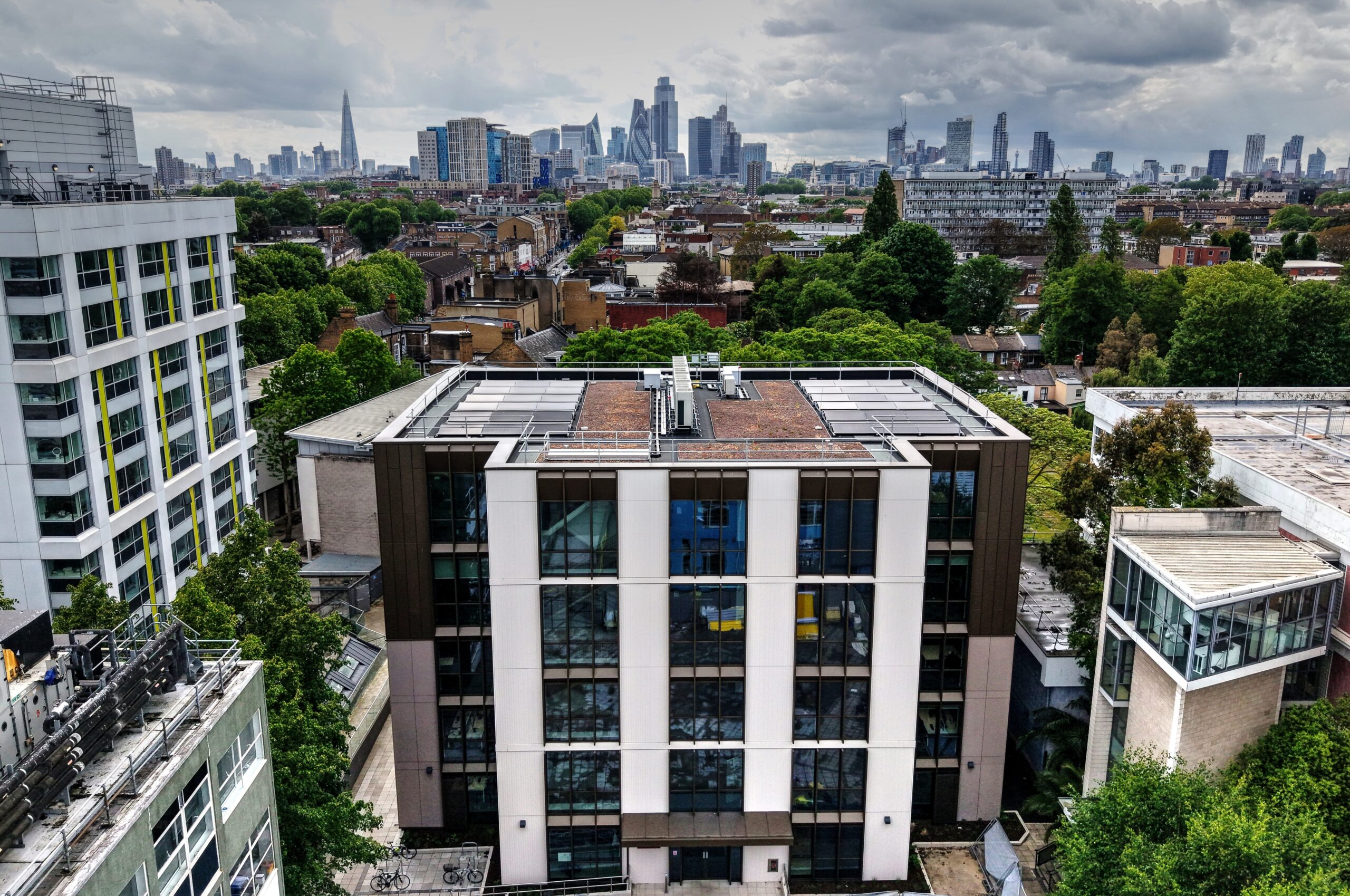
The ITL comprises multiple facade systems and a complex curtain wall on an almost complete rebuild.
Wrapping the outdated building in a new, high-performance facade raised the major challenge of deflection accommodation between old and new structures. The facade design also needed to accommodate the weight of the new triple glazing and the feature fins required for summer shade.
The Sotech XTR concave profile was proposed by A²O as a more robust alternative to the original terracotta specification. Overall the facade called for intense collaboration with fabricators.
Given the location, components of the installation had to meet SBD (Secured by Design) standards.
There was very little storage space for the curtain wall components and the site was live throughout.
H&S was an issue with working at height up to 5 storeys and installing the 5-storey curtain wall.
As work exposed the retained structure, on-site measurements were needed to optimise precision.
The Retofit had to achieve BREEAM Excellent, using a fabric-first approach with 270mm insulation, and requiring demanding levels of air tightness.
Solutions
A²O were engaged at Stage 4 design to help shape crucial logistics, technical & buildability decisions.
The deflection acommodation added to the live-load slab deflection exceeded the capability of a typical stick curtain wall system. Kawneer created an enhanced expansion joint to accommodates movement of up to +/-15mm. A²O divided the curtain wall into 5 separate screens for buildability.
Early engagement allowed a rolling start when supply chain appointments were concluded speeding up interface coordination and reducing design meeting time in the lead-up to start on site.
A²O installed a number of SBD doors, strengthening the building’s resistance to break-ins.
Despite the very limited storage space, the curtain wall was installed avoiding damage to the glazing.
A²O achieved a couple of 100% scores from the Heath & Safety consultant Havio.
The quality of A²O‘s workmanship scored highly on Willmott Dixon’s NQA inspections.
The facade exceeded PassivHaus U-Values; achieved 2.8m3/(h.m2) on airtightness and an EPC Energy Rating of A, with Asset Rating of only 8.
Fact File
Sector
- Education
STATUS
- Rebuild: Refurb, Retrofit & 2 Extensions
Value
- £2,175,000
Scope of Work
- AA110 HI Curtain Wall, optimising natural light & solar gain and feature fins for summer shade
- Aluminium Concave Planks, Sotech XTR
- Fibre-cement Panels, Equitone Linea, L: G-3
- Aluminium Cassette Panels, Level: 4-5
- Aluminium Bracketry, recycle-grade by RJFS
- Rainscreen Slab Insulation
- Fire Barriers
- SFS & Y-Wall Board
- Bespoke Entrance Canopy, bronze aluminium
- Bespoke Cappings & Flashings